 |
|
You are here: Foswiki>Shem Web>JesenyaWounds (09 Apr 2012, BillyRayStupendous)Edit Attach
There are several major cultural regions of Jesenya: the Galdish, the Dhunnic, the Talunese, the Kerupene, the Kearin, the Innesian, the Berellian, the Aeslan, and the Flowerkin areas are the most significant, but there are others. The tribes that made up the original peoples of Jesenya are related closely to those of Ranu and Mati, and many have connections to the Lyrillans.
Galdish region:
Bulles: Champagna. Known the world over for its sparkling wines, Bulles is one of the most influential regions in the Galdish area. It has long been fought over, and it has a rivalry with Vieux Terre. It is also a lead producer of other wines besides the sparkling variety. White grapes are a symbol of the region.
Cote Nue: Monaco. Considered something of a coastal paradise, Cote Nue is a principality that has remained largely independent over the course of its history. A lot of Ranic influence remains in the region, and much Talunese as well. The royal family has many ties to various Talunese states. The region has a decadent reputation, owing a lot to the gambling industry there. Its national symbol is a leaping fish.
Couronne Epee: Napoleonic France. Couronne Epee is the remnants of the Galdish empire that once stretched from northern Jesenya to northern Ranu. Its rulers are still referred to as the Imperial family, though it has few imperial colonies now. The nation is a very proud, bellicose nation, though they have a very fair and reasonable legal system. They have much enmity for Dhunnics and Sacra Vittans. Their national symbol is a crown at the end of a sword.
D'onde: Aquitaine. The D'ondenne are mostly robins. Their small nation is known for its beauty and historically fluctuating borders. The people are of Lyrillan and Matian (especially Jael) descent as well as Jesenyan. It has been ruled by the Galdish for most of its history, but the Dhunnics laid claim to it for many decades. Many Ages ago, a Galdish emperor declared a king of D'onde while he held sway over it, while the people elected a different ruler. This war has had lingering effects on the region's politics. Wine, bull-fighting, and surfing are important cultural cornerstones.The robins are considered national symbols there.
Galdun: France. Flutters are native to this region. Galdun is the central nation of the Galdish region, and the largest. It is one of the most powerful nations in the world, and it has cultural influence over the entire region, if not actual power. Its symbol is the butterfly, for the flutters who are native to the nation and its most valued citizens. Not even the hardline revolutionaries that are currently rising up dare harm the flutters, who are beings of beauty and dreams. Galdun is ruled by a royal family with ancient roots, and the powerful nobility are at odds with an increasingly angry populace. The city of Fer is the hotspot of the rebellion. It has gone from being a major trading city to a massive, anarchistic commune. Though a full civil war has not been declared, many feel it's inevitable.
Hiverae: Normandy. Hiverae is heavily influenced by Kearin, Dhunnic, and Berellian peoples, but it remains very distinctly Galdish. It has fallen undersway of Dhun at times, and for a while, Hiveraenne lords ruled Dhun. Now, though, it is a semi-autonomous region of Galdun. It is known for its fine foods and drink. Its symbol is three leopards.
Javelot: Franks.The Javels were the first Galdish peoples. They came from the east by river, possibly all the way from Ranu after crossing the Indigo Sea. In the early years of Galdun, the Javels were the conquerors of the regions whose genetic stock forms the basis of the Galdish peoples. They were powerful tribes who formed an early, rudimentary empire. The region of Javelot is comprised of those tribes that never advanced beyond semi-nomadic, territorial tribalism, usually because of religious or magical cultural practices. They are considered primitives to most Galds, but their presence is tolerated because they are very powerful, and they keep the Kerupenes to the east and the Dhunnics to the north from invading. Their symbol is the dream-catcher.
Orre: Orleans. Orre is an important region of the Galdish territories for its strategic geographical location, its historical significance as a former capital, and its powerful economy based on financial trading and the fact that many guilds are centered there. Its symbol is the fleur de lys.
Pense: Savoy/Nice. Pense is a mountainous coastal region next to Emmoi, with strong ties to Talunese regions. Its history is one of shifting allegiances, but it has always had a strong Galdish population. It currently is known for its strong ties to Talune. Many fear it will shift allegiances once more, removing itself from the alliance that keeps the populace from rising up. Its symbol is a trio of mountain tops.
Vieux Terre: Burgundy. A heavily Kerupene influenced region, Vieux Terre is called the "old land" because it is the first area recognized by the Galdish as a Galdish state. When the Javels finally let their empire dissolve, Vieux Terre was formed as the first Galdish state, and ever since, it has been considered the heartland of Galdun. Wine and food are the biggest cultural cornerstones, and in this area, they are the rivals to Bulles. Its symbol is a bunch of red grapes. Galdun is currently divided as such: the King and Queen rule from Opardem in Galdun proper. Dukes rule Orre, D'onde, Vieux Terre, Hiverae, and Bulles. Couronne Epee, Pense, Cote Nue, and Javelot are independent. Couronne Epee is ruled by an Emperor and Empress, though they are not very powerful. Pense is ruled by a Duke. Cote Nue is ruled by a Prince. Javelot is ruled by the tribal leaders. Fer, the city in Galdun, is under control of the revolution, which has strength in all of the duchies, Cote Nue, and Couronne Epee. Javelot and Pense are largely unaffected by it. Powerful economic forces include the Spicers' Guild, Monsapple Trading Company, the Vineyards, and the Bakers' Guild.
Aeslan:
Aeslaw: Poland. Cornucopians are from here. The cornucopians were the first to settle Aeslaw, but Ranic peoples soon came west and settled there, mixing with the populations. Some say the cornucopians came from the west, from Lyrilla, originally. These people were converted en masse to the faith in the Amber Goddess over the course of a few centuries. During Agikaani occupation, Aeslaw was subject to many, many concentration camps, and their ruins remain there to this day, though most are closely guarded and forbidden. Riverkin have strong ties to the Aeslan communities. The Aeslans have always had ties to their Ranic origins, and they maintain a friendly relationship with Paurev especially. Aeslaw became a commonwealth and created one of the freest nations in the world. Their national symbol is the fascha.
Wybrzezu: Pomerania. A mix of Kerupene and Aeslan communities, Wybrzezu is a semi-autonomous region of Aeslaw. It was subject to the mass conversions to the Amber Faith that Aeslaw was, but it retained some of its Kerupene roots. It still maintains a small nobility, unlike Aeslaw, but it is subject to the laws regarding freedom that Aeslaw maintains. It has long been a battleground state, and this history is soaked into the soul there. Its symbol is an amber apple. Aeslaw is a strong nation, but it does not have much influence outside of its own borders. It has an unfortunate reputation as being a land of ignorant folk, but this stereotype could not be further from the truth. It is a land with a strong national identiy, religion, and military. It has several top level universities, and many leading philosophers, physicists, and astronomers have come from Aeslaw. Despite their strong national identity, Aeslans are not fond of nationalism. They believe fiercely in freedom (because of a sharp memory for times of occupation), and they are strongly opposed to the more aggressive nations like Stolzen, Insieme, Couronne Epee, and so on.
Dhunnic:
Albion: Brittony. Swan maidens are from here, living in secluded lakes and mountains mostly. Albion lies between Dhun and Innes, and its culture is something of a mix between the two. It is said to have been settled by legendary Talunese, ancient tribesmen and giatnts, and faeries from north in Lyrilla, and the people there are descended from these and the swan maidens. Albion is a holy land of just and good knights whose ancestries stretch back to the founding of the Dhunnic regions. They are the original Dhunnics. Their symbol is a swan's egg.
Anstigacsa: Anglia. Revenants originated here. One of the more Kerupene influenced regions of the Dhunnic territories, Anstigacsa was independent for many centuries, until too much war and raiding from Jorgendish on the Indigo Sea made them form a union with Dhun. They have strong roots in faiths other than the Swan Faith, and this sets them apart. Special laws allow them to continue these traditions, and this makes them something of a second class citizenry in Dhun. Their symbol is a brown wreath.
Bewindla: Kent. An ancient land scattered with quarries and megaliths, Bewindla has been settled by dozens of tribes over the centuries. It began to become more stable when the High Priest in Sacra Vitta named the bishop in Bewindla's capital as his successor for many years, leading to an influx of law-and-order religious sorts. Curiously, though home to many different peoples, it has never been taken by conquest while an independent state. Having willingly become part of Dhun, it was conquered during the Agikaani conquests and other worldwide conflicts. Still, it is proud to call itself the "undefeated kingdom," even though it is now a duchy of Dhun. Currently, it is home to a peasant uprising. Bewindla is home to a powerful navy. The duke's symbol is a stallion. The peasant uprising's symbol is a man impaled on a lance, an effigy of their martyred leader.
Dhun: Arthurian/Medieval England. Dhun is the center of the Dhunnic territories. It is ruled by a king and queen, and there is a national faith (Swan Faith) that enforced by law. Heavily influenced by many outside groups, including Ranic raiders from Jorgendheim and Remak, Kerupene tribes, Galdish tribes, and faeries from Lyrilla, Dhun is a land of mixed ancestries but common faith. There are seven "kindgoms" within the kingdom, but all fall under sway of Dhun. The capital is Swanstone, and the symbol is a swan.
Geathne: Lindsey. A very wet sub-kingdom of Dhun, Geathne is ancient but long fallen from power. Indeed, though it retains a reputation for once having been great, this seems to have been before any historical records. While not a great nation, the people of Geathne are a proud one. Their symbol is a shield split into six regions, representing the continuing conflicts that pull their small land apart.
Grenz: Mercia. Changelings were first born here, or so they say. Grenz is the central region of the Dhunnic territories. In the earliest days, it was considered the boundary between the seven sub-kingdoms, making it something of a battleground state. It rose to power for many decades, but ultimately, the stresses of war brought it into the fold of Dhun's power. Its symbol is a two-headed dog.
Piran: Cornish. Often considered little more than a mining colony to the main land Dhunnics, Zand Isle is actually an ancient territory with many traditions and distinct cultural practices. It is actually fairly closely related to Keary, but it is politically part of Dhun. Though it has converted to Swan Faith, it still holds many Kearin traditions, blending them into a set of curious practices that set them apart. Its symbol is a golden lizard.
Zand Isle: Manx. Arkan sonneys are from here. Zand Isle is a semi-autonomous nation off the coast of Dhun, close to Innes. It has, in the psat, belonged to both nations, but currently, Dhun holds sway. Ranic raiders, Kearins, Innesians, and Dhunnics have all settled on the island, but the original inhabitants have a strong presence in the stock there as well. There are many ancient megaliths on the island. They are followers of the Swan Faith, and though many sailors serve the Goddess of the Seas. Many say the island was formed when a Kearin giant threw a piece of land at a Dhunnic enemy, and the Mother of the Seas reached up and grabbed it. Their symbol is a triskedelion of legs. Dhun is ruled by the Caer family, the third dynasty to control the region. They have the sword Demonslayer, which belonged to the first Champion of Light before her death and is her Relic. Knights of Dhun are paladins of the Swan Faith if they are not married. A knight of Dhun who is married is merely a knight, though most of them were paladins before settling down. Some paladins never marry, retiring to the priesthood or monastery when they grow old. Dhunnics believe there is a promised land on Shem they were once a part of far to the west, perhaps in the forgotten regions of western Starfall. Albion, Antigacsa, Bewindla, Geathne, Grenz, and Piran are duchies in Dhun, while Bewindla is also home to peasant rebellion communes. Zand Isle is semi-autonomous and ruled by a council.
Innesian:
Glen Gaes: Scottish Lowlands. Sluagh.
Innes: Scottish Highlands. Chomghur.
Metan: Pictish.
Nochsgladden: Caledonia.
Kearin:
Ardri: Ulster. Baobhan.
Fluirseach: Hibernia.
Keary: Ireland.
Tailte Sionnach: Gael.
Tire Aisling: Celt.
Talunese:
Alveo: Venice.
Audace: Verona.
Barra: Corsica.
Basse Colline: Piedmont.
Bocca: Genoa.
Campione: Lombardia.
Collo: Basilicata.
Demopolis: Sicily. Taupe dragon.
Frescara: Sardinia.
Guarigione: Tuscany.
Insieme: Fascist Italy.
Laccio: Salerno.
Meta Percorso: Milan.
Pacum: San Marino.
Puraria: Calabria.
Rameferro: Etruscan.
Rene: Umbria.
Sacra Vitta: Holy See. Glory.
Scudola: Spoleto. Hrume.
Talune: Naples/Rome.
Tregua: Perugia.
Berellian:
Berellia: Wales. Boghym, beryl dwarf, dryad, mahogany.
Bridge Gate: Waygate.
City of the Moons: Werewolf.
Tarenthal: Wales. Greater empath, the gysylltiad, bridgekeeper, bridgedweller troll, cyhyraeth.
Kerupene:
Bergenen: Liechtenstein.
Heiligwald: Holy Roman Empire.
Hochlund: Vandal.
Kerupen: Germany.
Loewenaal: Saxony. Uris.
Niffel: Bavaria.
Ordnungen: Teuton.
Ostenregen: Ostrogoth.
Redneren: Hesse.
Ritse: Frisia.
Sinter: Austria.
Soldrath: Prussia.
Stolzen: Nazi Germany. Nachzehrer.
Strom: Rhineland.
Verlorenregen: Visigoth.
Flowerkin:
Chrysanthemum Empire: Byzantium.
King Gate: Waygate.
Other:
Baraus: Netherlands. Bokkerijder.
Emmoi: Flanders. Ulus-tythe.
Kalter: Switzerland.
Lichtburg: Luxembourg.
Wutte: Belgium.
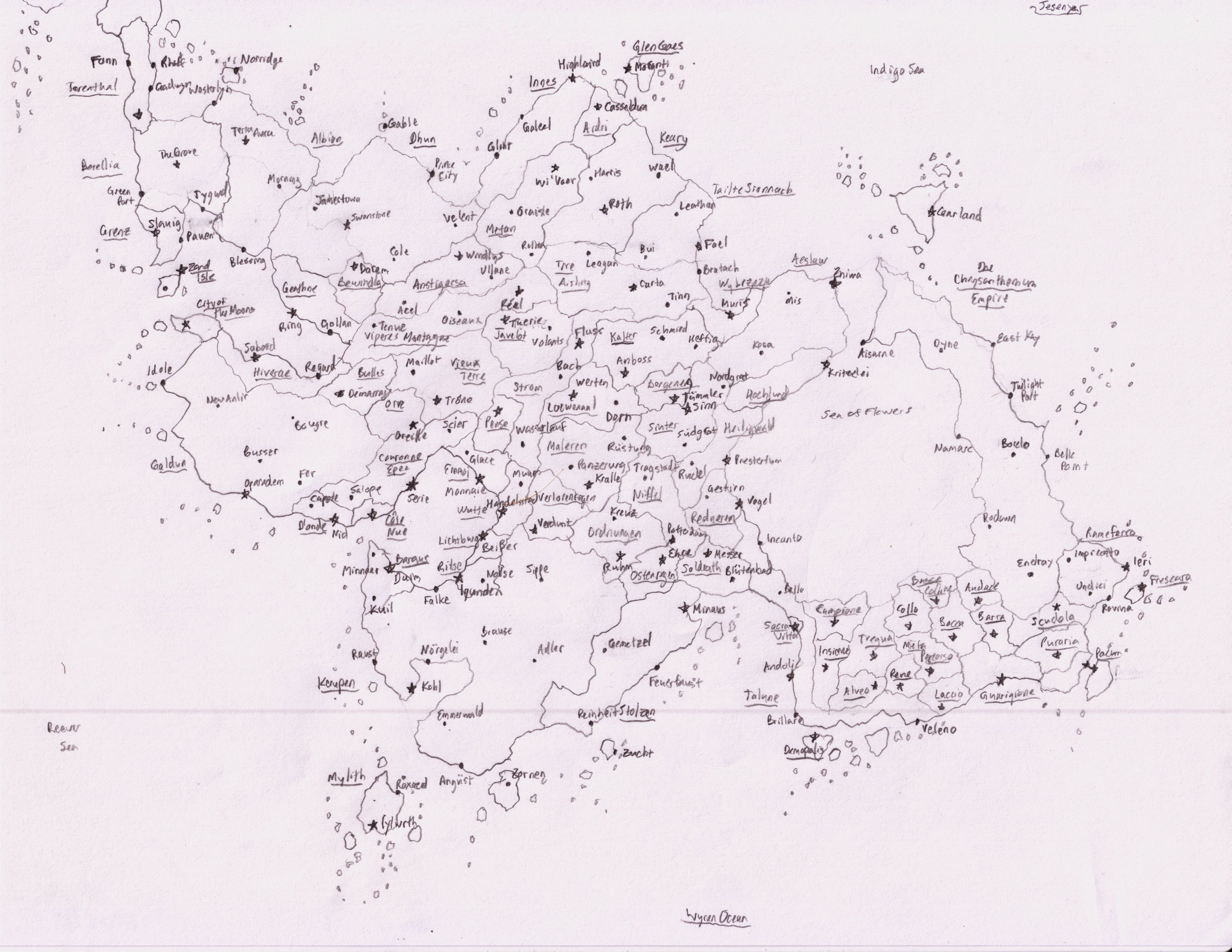
Mylith: Intraphalan. Jesenya Wounds Map:
Bulles: Champagna. Known the world over for its sparkling wines, Bulles is one of the most influential regions in the Galdish area. It has long been fought over, and it has a rivalry with Vieux Terre. It is also a lead producer of other wines besides the sparkling variety. White grapes are a symbol of the region.
Cote Nue: Monaco. Considered something of a coastal paradise, Cote Nue is a principality that has remained largely independent over the course of its history. A lot of Ranic influence remains in the region, and much Talunese as well. The royal family has many ties to various Talunese states. The region has a decadent reputation, owing a lot to the gambling industry there. Its national symbol is a leaping fish.
Couronne Epee: Napoleonic France. Couronne Epee is the remnants of the Galdish empire that once stretched from northern Jesenya to northern Ranu. Its rulers are still referred to as the Imperial family, though it has few imperial colonies now. The nation is a very proud, bellicose nation, though they have a very fair and reasonable legal system. They have much enmity for Dhunnics and Sacra Vittans. Their national symbol is a crown at the end of a sword.
D'onde: Aquitaine. The D'ondenne are mostly robins. Their small nation is known for its beauty and historically fluctuating borders. The people are of Lyrillan and Matian (especially Jael) descent as well as Jesenyan. It has been ruled by the Galdish for most of its history, but the Dhunnics laid claim to it for many decades. Many Ages ago, a Galdish emperor declared a king of D'onde while he held sway over it, while the people elected a different ruler. This war has had lingering effects on the region's politics. Wine, bull-fighting, and surfing are important cultural cornerstones.The robins are considered national symbols there.
Galdun: France. Flutters are native to this region. Galdun is the central nation of the Galdish region, and the largest. It is one of the most powerful nations in the world, and it has cultural influence over the entire region, if not actual power. Its symbol is the butterfly, for the flutters who are native to the nation and its most valued citizens. Not even the hardline revolutionaries that are currently rising up dare harm the flutters, who are beings of beauty and dreams. Galdun is ruled by a royal family with ancient roots, and the powerful nobility are at odds with an increasingly angry populace. The city of Fer is the hotspot of the rebellion. It has gone from being a major trading city to a massive, anarchistic commune. Though a full civil war has not been declared, many feel it's inevitable.
Hiverae: Normandy. Hiverae is heavily influenced by Kearin, Dhunnic, and Berellian peoples, but it remains very distinctly Galdish. It has fallen undersway of Dhun at times, and for a while, Hiveraenne lords ruled Dhun. Now, though, it is a semi-autonomous region of Galdun. It is known for its fine foods and drink. Its symbol is three leopards.
Javelot: Franks.The Javels were the first Galdish peoples. They came from the east by river, possibly all the way from Ranu after crossing the Indigo Sea. In the early years of Galdun, the Javels were the conquerors of the regions whose genetic stock forms the basis of the Galdish peoples. They were powerful tribes who formed an early, rudimentary empire. The region of Javelot is comprised of those tribes that never advanced beyond semi-nomadic, territorial tribalism, usually because of religious or magical cultural practices. They are considered primitives to most Galds, but their presence is tolerated because they are very powerful, and they keep the Kerupenes to the east and the Dhunnics to the north from invading. Their symbol is the dream-catcher.
Orre: Orleans. Orre is an important region of the Galdish territories for its strategic geographical location, its historical significance as a former capital, and its powerful economy based on financial trading and the fact that many guilds are centered there. Its symbol is the fleur de lys.
Pense: Savoy/Nice. Pense is a mountainous coastal region next to Emmoi, with strong ties to Talunese regions. Its history is one of shifting allegiances, but it has always had a strong Galdish population. It currently is known for its strong ties to Talune. Many fear it will shift allegiances once more, removing itself from the alliance that keeps the populace from rising up. Its symbol is a trio of mountain tops.
Vieux Terre: Burgundy. A heavily Kerupene influenced region, Vieux Terre is called the "old land" because it is the first area recognized by the Galdish as a Galdish state. When the Javels finally let their empire dissolve, Vieux Terre was formed as the first Galdish state, and ever since, it has been considered the heartland of Galdun. Wine and food are the biggest cultural cornerstones, and in this area, they are the rivals to Bulles. Its symbol is a bunch of red grapes. Galdun is currently divided as such: the King and Queen rule from Opardem in Galdun proper. Dukes rule Orre, D'onde, Vieux Terre, Hiverae, and Bulles. Couronne Epee, Pense, Cote Nue, and Javelot are independent. Couronne Epee is ruled by an Emperor and Empress, though they are not very powerful. Pense is ruled by a Duke. Cote Nue is ruled by a Prince. Javelot is ruled by the tribal leaders. Fer, the city in Galdun, is under control of the revolution, which has strength in all of the duchies, Cote Nue, and Couronne Epee. Javelot and Pense are largely unaffected by it. Powerful economic forces include the Spicers' Guild, Monsapple Trading Company, the Vineyards, and the Bakers' Guild.
Aeslan:
Aeslaw: Poland. Cornucopians are from here. The cornucopians were the first to settle Aeslaw, but Ranic peoples soon came west and settled there, mixing with the populations. Some say the cornucopians came from the west, from Lyrilla, originally. These people were converted en masse to the faith in the Amber Goddess over the course of a few centuries. During Agikaani occupation, Aeslaw was subject to many, many concentration camps, and their ruins remain there to this day, though most are closely guarded and forbidden. Riverkin have strong ties to the Aeslan communities. The Aeslans have always had ties to their Ranic origins, and they maintain a friendly relationship with Paurev especially. Aeslaw became a commonwealth and created one of the freest nations in the world. Their national symbol is the fascha.
Wybrzezu: Pomerania. A mix of Kerupene and Aeslan communities, Wybrzezu is a semi-autonomous region of Aeslaw. It was subject to the mass conversions to the Amber Faith that Aeslaw was, but it retained some of its Kerupene roots. It still maintains a small nobility, unlike Aeslaw, but it is subject to the laws regarding freedom that Aeslaw maintains. It has long been a battleground state, and this history is soaked into the soul there. Its symbol is an amber apple. Aeslaw is a strong nation, but it does not have much influence outside of its own borders. It has an unfortunate reputation as being a land of ignorant folk, but this stereotype could not be further from the truth. It is a land with a strong national identiy, religion, and military. It has several top level universities, and many leading philosophers, physicists, and astronomers have come from Aeslaw. Despite their strong national identity, Aeslans are not fond of nationalism. They believe fiercely in freedom (because of a sharp memory for times of occupation), and they are strongly opposed to the more aggressive nations like Stolzen, Insieme, Couronne Epee, and so on.
Dhunnic:
Albion: Brittony. Swan maidens are from here, living in secluded lakes and mountains mostly. Albion lies between Dhun and Innes, and its culture is something of a mix between the two. It is said to have been settled by legendary Talunese, ancient tribesmen and giatnts, and faeries from north in Lyrilla, and the people there are descended from these and the swan maidens. Albion is a holy land of just and good knights whose ancestries stretch back to the founding of the Dhunnic regions. They are the original Dhunnics. Their symbol is a swan's egg.
Anstigacsa: Anglia. Revenants originated here. One of the more Kerupene influenced regions of the Dhunnic territories, Anstigacsa was independent for many centuries, until too much war and raiding from Jorgendish on the Indigo Sea made them form a union with Dhun. They have strong roots in faiths other than the Swan Faith, and this sets them apart. Special laws allow them to continue these traditions, and this makes them something of a second class citizenry in Dhun. Their symbol is a brown wreath.
Bewindla: Kent. An ancient land scattered with quarries and megaliths, Bewindla has been settled by dozens of tribes over the centuries. It began to become more stable when the High Priest in Sacra Vitta named the bishop in Bewindla's capital as his successor for many years, leading to an influx of law-and-order religious sorts. Curiously, though home to many different peoples, it has never been taken by conquest while an independent state. Having willingly become part of Dhun, it was conquered during the Agikaani conquests and other worldwide conflicts. Still, it is proud to call itself the "undefeated kingdom," even though it is now a duchy of Dhun. Currently, it is home to a peasant uprising. Bewindla is home to a powerful navy. The duke's symbol is a stallion. The peasant uprising's symbol is a man impaled on a lance, an effigy of their martyred leader.
Dhun: Arthurian/Medieval England. Dhun is the center of the Dhunnic territories. It is ruled by a king and queen, and there is a national faith (Swan Faith) that enforced by law. Heavily influenced by many outside groups, including Ranic raiders from Jorgendheim and Remak, Kerupene tribes, Galdish tribes, and faeries from Lyrilla, Dhun is a land of mixed ancestries but common faith. There are seven "kindgoms" within the kingdom, but all fall under sway of Dhun. The capital is Swanstone, and the symbol is a swan.
Geathne: Lindsey. A very wet sub-kingdom of Dhun, Geathne is ancient but long fallen from power. Indeed, though it retains a reputation for once having been great, this seems to have been before any historical records. While not a great nation, the people of Geathne are a proud one. Their symbol is a shield split into six regions, representing the continuing conflicts that pull their small land apart.
Grenz: Mercia. Changelings were first born here, or so they say. Grenz is the central region of the Dhunnic territories. In the earliest days, it was considered the boundary between the seven sub-kingdoms, making it something of a battleground state. It rose to power for many decades, but ultimately, the stresses of war brought it into the fold of Dhun's power. Its symbol is a two-headed dog.
Piran: Cornish. Often considered little more than a mining colony to the main land Dhunnics, Zand Isle is actually an ancient territory with many traditions and distinct cultural practices. It is actually fairly closely related to Keary, but it is politically part of Dhun. Though it has converted to Swan Faith, it still holds many Kearin traditions, blending them into a set of curious practices that set them apart. Its symbol is a golden lizard.
Zand Isle: Manx. Arkan sonneys are from here. Zand Isle is a semi-autonomous nation off the coast of Dhun, close to Innes. It has, in the psat, belonged to both nations, but currently, Dhun holds sway. Ranic raiders, Kearins, Innesians, and Dhunnics have all settled on the island, but the original inhabitants have a strong presence in the stock there as well. There are many ancient megaliths on the island. They are followers of the Swan Faith, and though many sailors serve the Goddess of the Seas. Many say the island was formed when a Kearin giant threw a piece of land at a Dhunnic enemy, and the Mother of the Seas reached up and grabbed it. Their symbol is a triskedelion of legs. Dhun is ruled by the Caer family, the third dynasty to control the region. They have the sword Demonslayer, which belonged to the first Champion of Light before her death and is her Relic. Knights of Dhun are paladins of the Swan Faith if they are not married. A knight of Dhun who is married is merely a knight, though most of them were paladins before settling down. Some paladins never marry, retiring to the priesthood or monastery when they grow old. Dhunnics believe there is a promised land on Shem they were once a part of far to the west, perhaps in the forgotten regions of western Starfall. Albion, Antigacsa, Bewindla, Geathne, Grenz, and Piran are duchies in Dhun, while Bewindla is also home to peasant rebellion communes. Zand Isle is semi-autonomous and ruled by a council.
Innesian:
Glen Gaes: Scottish Lowlands. Sluagh.
Innes: Scottish Highlands. Chomghur.
Metan: Pictish.
Nochsgladden: Caledonia.
Kearin:
Ardri: Ulster. Baobhan.
Fluirseach: Hibernia.
Keary: Ireland.
Tailte Sionnach: Gael.
Tire Aisling: Celt.
Talunese:
Alveo: Venice.
Audace: Verona.
Barra: Corsica.
Basse Colline: Piedmont.
Bocca: Genoa.
Campione: Lombardia.
Collo: Basilicata.
Demopolis: Sicily. Taupe dragon.
Frescara: Sardinia.
Guarigione: Tuscany.
Insieme: Fascist Italy.
Laccio: Salerno.
Meta Percorso: Milan.
Pacum: San Marino.
Puraria: Calabria.
Rameferro: Etruscan.
Rene: Umbria.
Sacra Vitta: Holy See. Glory.
Scudola: Spoleto. Hrume.
Talune: Naples/Rome.
Tregua: Perugia.
Berellian:
Berellia: Wales. Boghym, beryl dwarf, dryad, mahogany.
Bridge Gate: Waygate.
City of the Moons: Werewolf.
Tarenthal: Wales. Greater empath, the gysylltiad, bridgekeeper, bridgedweller troll, cyhyraeth.
Kerupene:
Bergenen: Liechtenstein.
Heiligwald: Holy Roman Empire.
Hochlund: Vandal.
Kerupen: Germany.
Loewenaal: Saxony. Uris.
Niffel: Bavaria.
Ordnungen: Teuton.
Ostenregen: Ostrogoth.
Redneren: Hesse.
Ritse: Frisia.
Sinter: Austria.
Soldrath: Prussia.
Stolzen: Nazi Germany. Nachzehrer.
Strom: Rhineland.
Verlorenregen: Visigoth.
Flowerkin:
Chrysanthemum Empire: Byzantium.
King Gate: Waygate.
Other:
Baraus: Netherlands. Bokkerijder.
Emmoi: Flanders. Ulus-tythe.
Kalter: Switzerland.
Lichtburg: Luxembourg.
Wutte: Belgium.
Mylith: Intraphalan. Jesenya Wounds Map:
- jesenya_wounds.jpg:
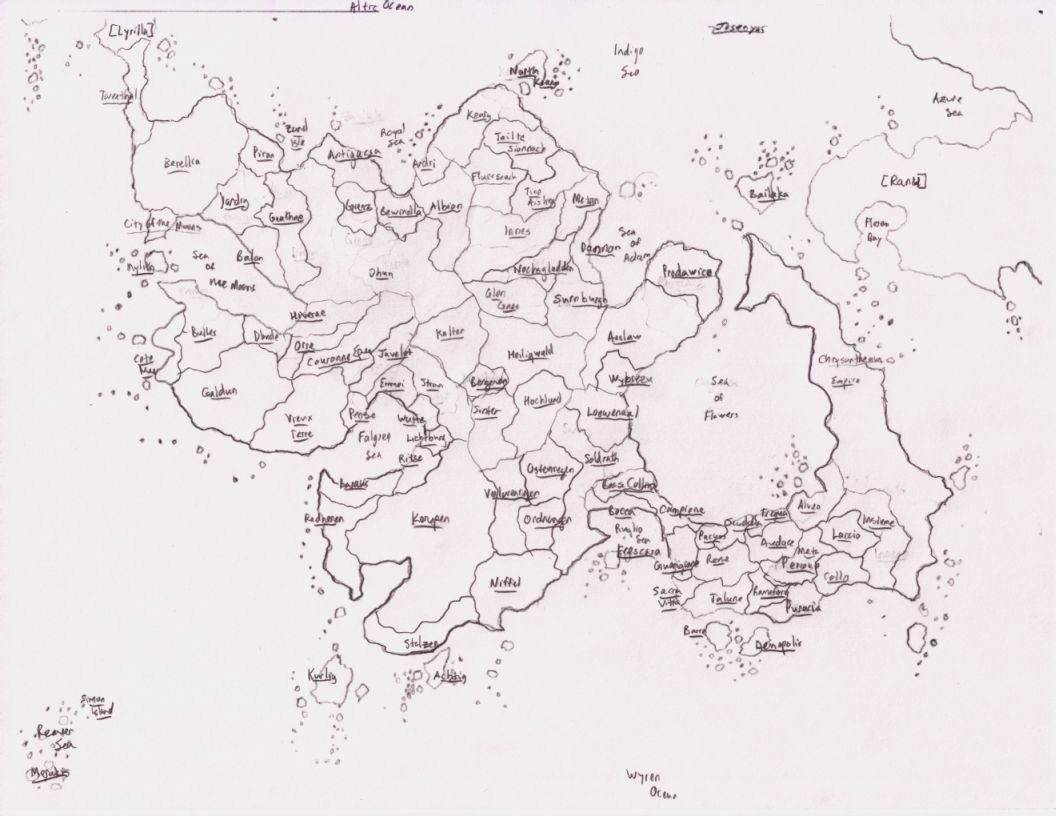


| I | Attachment | Action | Size | Date | Who | Comment |
|---|---|---|---|---|---|---|
 jpg jpg |
jesenya_wounds.jpg | manage | 96 K | 09 Apr 2012 - 02:51 | UnknownUser | |
 JPG JPG |
jesenya_wounds0001.JPG | manage | 1 MB | 28 Jan 2012 - 00:53 | UnknownUser | Jesenya Wounds Map |
Edit | Attach | Print version | History: r5 < r4 < r3 < r2 | Backlinks | View wiki text | Edit wiki text | More topic actions
Topic revision: r5 - 09 Apr 2012, BillyRayStupendous


 GrandGuignol

 Copyright © by the contributing authors. All material on this collaboration platform is the property of the contributing authors.
 Ideas, requests, problems regarding Foswiki? Send feedback